How it works
Two people co-own a home. One lives in it and runs it. The other simply holds equity. A non-profit keeps the score and applies the same fair rules to both — and there's no bank in the middle.
The model
A Resident Owner buys the share of a home they can afford. A Passive Owner — often the home's existing owner — holds the rest. They own it together as tenants in common, both registered on the title. The Resident Owner occupies the whole home as an owner, not a tenant.
Step by step
Choose the home and the portion you can afford — starting from 20%. A Passive Owner holds the balance.
A standard co-ownership deed drafted with Chapman Tripp. You're registered on the title as a co-owner.
Pets, paint, renovations — all your call. You occupy the whole home as your principal residence.
An occupancy fee on just the share you don't yet own — set below market rent, and fixed for the term. (See how it's calculated.)
There is no requirement to own 100% of the home — choose whatever % works for you. Top up your share whenever you can, at index-linked prices.
You can sell the home any time, by any method you like, so long as the Passive Owner is paid out. The Passive Owner can sell their interest to anyone at any time, and that will not affect the Resident Owner.
How value flows
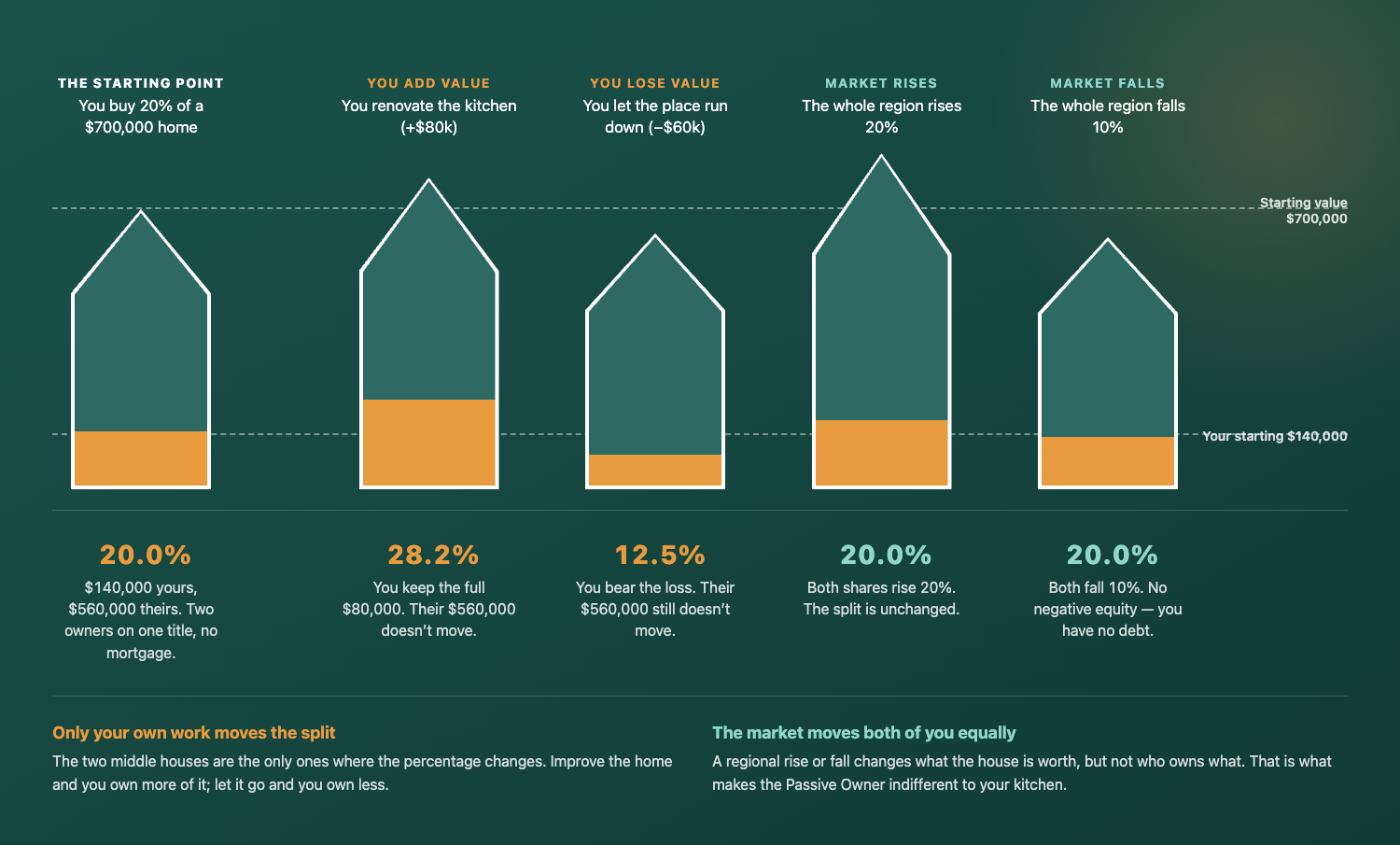
The Passive Owner's share always tracks the regional-average change in price. So any value you add above that — and any loss you cause below it — flows to you, the Resident Owner. It's the mechanism that makes this co-ownership without the usual co-ownership conflict.
The ownership register
An ownership register records exactly what each of you owns. It's updated every quarter, and only three things can ever move it.
Passive Owner = previous × (1 + index) − top-up Resident Owner = new value − Passive Owner The Passive Owner tracks the market average exactly. The Resident Owner gets everything specific to this home — the gains they create and the losses they cause.
Fees & costs
Illustrative, on a $700k home. The occupancy fee is set below market rent and charged only on the share you don't yet own. GST applies to the Administration Fee, not to the occupancy fee or top-ups.
If things change
A new way to own should answer the hard questions up front. Here's what happens when life, or the market, moves.
Where to next
The model is built for both parties. Pick your path, or run your own numbers.