The economics
Why home loans are so expensive
Borrowing hundreds of thousands of dollars is a costly path to a home — and almost every one of those costs disappears under co-ownership.
Why borrowing hundreds of thousands of dollars is a difficult and expensive path to homeownership
A typical home loan involves borrowing many hundreds of thousands of dollars, using up to 30% of your income, with repayments taking up to 30 years. Imagine offering the same terms for any other investment: shares in just one company, gold, or bitcoin. It would likely be illegal. We do it for a home because there has been no other option. Until now.
Why bank mortgage borrowing is so expensive
Here are the main reasons why bank mortgage borrowing costs so much more than most people realise — and why almost every one of these costs disappears under the Passive Partnerships co-ownership model.
- Net Interest Margin (core profit)
The bank borrows money cheaply (term deposits, wholesale markets) and lends it to you at a higher rate. That spread — typically 1.5–2.5% — is pure margin going to bank administration and profit.
- Shareholder return requirements
NZ’s big four banks (ANZ, ASB, BNZ, Westpac) are Australian-owned and must generate returns for offshore shareholders — typically 12–15% return on equity. This is baked into every mortgage rate. Currently over $6.5 billion heads to Australia every year in pure profit.
- Cost of funds / wholesale borrowing
Banks themselves borrow from international wholesale money markets, which carry risk premiums, currency hedging costs (NZD is a small currency), and liquidity margins — all passed to borrowers.
- Reserve Bank capital requirements
Since 2020, RBNZ requires NZ banks to hold significantly more Tier 1 capital (up to 18% of risk-weighted assets). More capital tied up = higher cost of lending passed to borrowers.
- Loan Loss Provisioning
Banks must set aside capital to cover expected and unexpected defaults across their whole mortgage book. Even if you never miss a payment, you’re subsidising the cost of those who do.
- Credit assessment costs
Underwriting a mortgage involves valuations, credit checks, income verification, AML/KYC compliance — real costs per application.
- AML/KYC and regulatory compliance
Anti-money laundering, know-your-customer, and CCCFA (Credit Contracts and Consumer Finance Act) compliance in NZ is substantial — requiring large compliance teams and systems.
- Branch and distribution network
Physical branches, mortgage advisers, broker commissions (typically 0.55–0.85% upfront + trail commissions) — all funded by borrowers through the margin.
- Mortgage broker trail commissions
Many borrowers use brokers who receive ongoing trail commissions for the life of the loan — a hidden cost embedded in the rate.
- IT and banking infrastructure
Core banking systems, online platforms, cybersecurity, and fraud prevention are massive ongoing costs for large retail banks.
- Loan administration over decades
Servicing a 25–30 year mortgage — statements, rate resets, top-ups, customer service — has a real per-account cost across the life of the loan.
- Interest compounding over 25–30 years
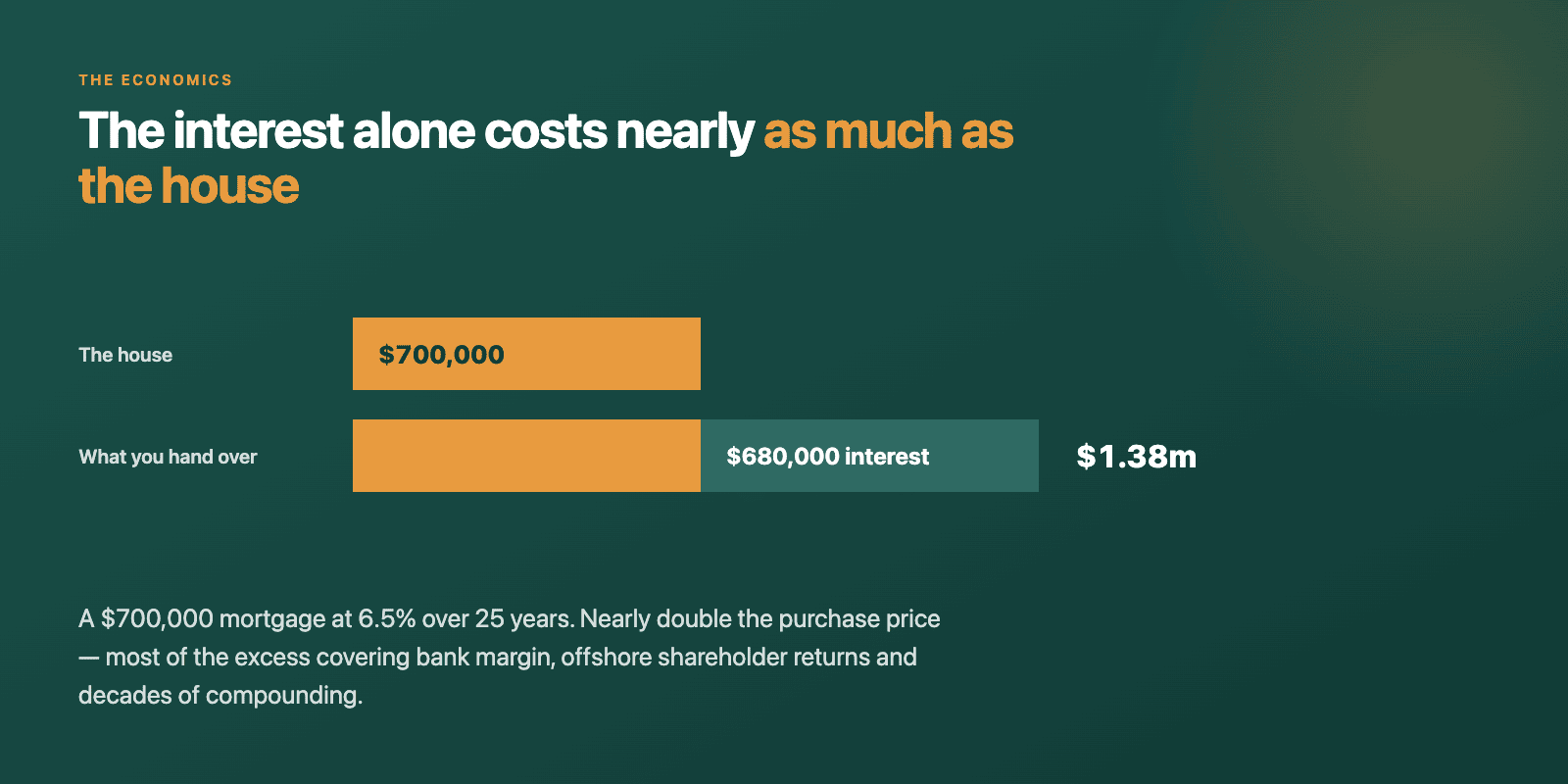
At 6.5% over 25 years, a $700k mortgage costs roughly $680,000+ in interest alone — more than the original purchase price. The time value of money works heavily against borrowers.
- LVR-based risk pricing
Borrowers with less than 20% deposit pay higher rates because the bank prices in higher default risk at high loan-to-value ratios.
- Fixed rate break fees
If you repay or refinance a fixed mortgage early, banks charge break fees to recover their hedging costs — another one-sided cost borne by the borrower.
- Inflation risk premium
Lenders price in an inflation risk premium over long terms — protecting themselves against the real value erosion of fixed repayments over decades.
- Opportunity cost of equity
As the borrower builds equity, that equity earns nothing until the property is sold or refinanced — unlike in a structure like Passive Partnerships where equity can be structured to work for both parties.
The bottom line
A $700k mortgage at ~6.5% over 25 years means the borrower pays back around $1.38 million total — nearly double the purchase price. A large part of that excess goes to a bank’s costs, compliance overhead, and ultimately offshore shareholder profits. It’s a structure optimised for the lender, not the borrower.
Passive Partnerships strips out every layer of bank cost
A bank mortgage is expensive because it’s a commercial lending product carrying profit margins, offshore shareholder returns, regulatory capital requirements, compliance overhead, broker commissions, and 25–30 years of compounding interest.
Passive Partnerships replaces all of that with a simple co-ownership structure where:
- No debt is created — there’s no loan, so no interest, no compounding, no break fees, no LVR risk pricing.
- No bank in the middle — no net interest margin, no capital adequacy costs, no AML/CCCFA compliance overhead, no branch network to fund.
- The investor’s return is index-linked — modest, transparent, and tied to actual economic reality rather than a commercial rate set to satisfy shareholder return targets.
- No broker or distribution costs — the structure is administered by a trust, not sold through a commission-based sales channel.
- No loan loss provisioning — the investor owns an actual share of a real asset, so there’s no default risk in the traditional sense. The security is the property itself.
- Non-profit administration — the trust structure is designed to recover costs only, not extract profit.
- Equity builds naturally — the Resident Owner’s growing equity stake reflects real value accumulation, not just the residual after decades of interest payments to a bank.
A bank mortgage is an expensive, risky financial product. Passive Partnerships is closer to what it actually is — two parties sharing ownership of a real asset, with a fair and simple mechanism where one party has the option to gradually buy the other out.
Play with the Homeowner calculator to see how these costs change with Passive Partnerships.
See it for yourself
Run your own numbers in the calculators, or join the waitlist to be part of the first cohort.
Open the calculators → Join the waitlist →