For investors/landlords
The same strategy as index funds — applied to property
Fifty years of evidence says you can't reliably beat the average in shares — so trillions moved to low-cost index funds. Passive Partnerships applies exactly that logic to residential property.
It's a deeply human instinct to believe we can beat the average — that our stock picks, our timing, or our property choices will outperform. That instinct is why people still pay large chunks of their KiwiSaver and investment returns to active fund managers, and why most landlords quietly assume they'll be one of the good ones.
Fifty years of evidence says this instinct is wrong for shares. There is a compelling case that the same structural logic applies to residential property — and Passive Partnerships is built directly on it.
Part one: why index investing won
Index investing has a strong, well-documented track record. Five structural reasons explain why.
- Costs compound. Index funds typically charge 0.03–0.20% a year, versus 0.5–1.5%+ for actively managed funds. Compounded over decades, that fee gap becomes one of the single largest drivers of the return difference between passive and active investors.
- Diversification reduces risk. Owning a broad index spreads risk across hundreds or thousands of businesses. No single company's failure, and no single manager's bad call, can sink the outcome.
- Most active managers underperform. The evidence here is stark, and it holds up in New Zealand's own market: 79% of New Zealand active large-cap equity funds underperformed their benchmark in 2025, and over the 15 years to December 2024, not one of 22 US equity fund categories had a majority of active managers beat their index. Even funds that do outperform rarely repeat it — S&P's persistence research found the persistence of top-quartile performance was worse than would be expected by pure chance. Picking tomorrow's winners in advance is, statistically, a coin flip at best.
- Market efficiency. Prices generally absorb new information quickly, so consistently finding mispriced stocks before the rest of the market does is difficult — especially once costs and tax are factored in.
- Behavioural advantage. Passive investors aren't tempted to time entries and exits or chase last year's winner. Removing that decision-making removes one of the most common sources of investor underperformance.
This is why trillions of dollars have shifted from active to passive investing over the last two decades. The evidence didn't change anyone's instincts — it just made the smarter default undeniable.
Part two: applying the same logic to property
Property investing has never had its "passive investing" moment. Every landlord assumes they'll beat the average — pick the right suburb, avoid the bad tenant, time the market well. But property carries the same structural problems as stock-picking: concentrated risk in a single asset, high recurring costs, and no reliable way to identify in advance which properties will actually outperform.
Passive Partnerships applies the passive-investing playbook to residential property ownership.
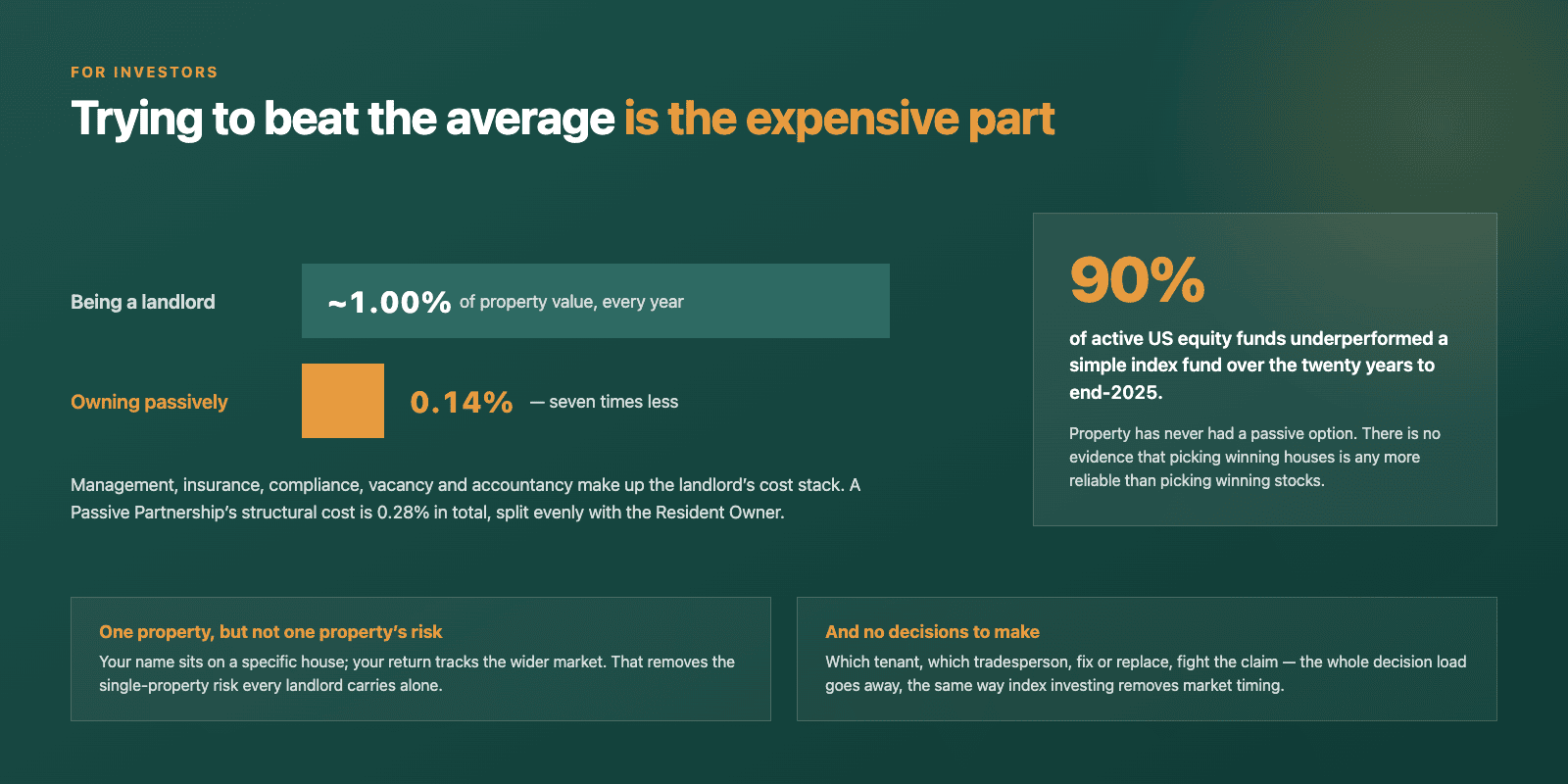
- Costs compound. Passive Partnerships' structural cost is around 0.14% a year to the investor (0.28% full running cost, split 50:50 with the Resident Owner). Being a landlord carries a heavier and less visible cost stack — property management, insurance, compliance, vacancy risk, accountancy. That can run closer to 1% of the property value a year, more than seven times the cost of owning passively. See the investor comparison →
- Diversification reduces risk. A key innovation of Passive Partnerships: your name sits on one specific property, but your financial performance is linked to the broader market. That structure dramatically reduces the single-property risk every traditional landlord carries alone.
- Most property investors underperform. Every landlord remembers their best decisions and quietly forgets the rest — the identifiable "winners" people point to after the fact are a small, unrepresentative sample, just as with stock-picking. There's no evidence that property-selection skill is any more common or persistent than fund-picking skill, and the SPIVA data above is the closest measurable proxy we have for how that plays out at scale.
- Market efficiency. Property prices, like share prices, generally reflect available information reasonably quickly. Consistently finding an underpriced property before the rest of the market does is hard — and harder again once agent fees, legal costs, and tax are factored in.
- Behavioural advantage. Being a landlord means an ongoing stream of decisions — which tenant, which tradesperson, when to fix versus replace, whether to fight a tribunal claim. Passive Partnerships removes that decision load entirely, freeing owners' time and headspace the same way passive investing frees investors from watching the market every day.
An investment strategy that aims for average performance doesn't sound like a great strategy. The problem is the high cost of trying to beat the average. For shares, the evidence has already won: trillions of dollars have moved to passive strategies. Property has never had that option. Now it does.
See the passive property numbers
Run the investor comparison — Passive Partnership against a standard rental and a term deposit on the same home.
Open the investor calculator → Register your interest →General information, not financial or investment advice, and past performance is not a guide to future returns. Fund and property fee figures are illustrative ranges; take independent advice before relying on any of it. SPIVA (S&P Indices Versus Active) figures are drawn from the S&P Dow Jones Indices SPIVA and Persistence Scorecards; property cost ranges from published NZ property-management fee data (e.g. Rentally). Current as at 2026.