Behind the model
How we keep the fees so low
How a non-profit Passive Partnership Administrator stays viable while charging a fraction of a bank or a property manager.
How does the Passive Partnerships Organisation make enough money for this to be viable?
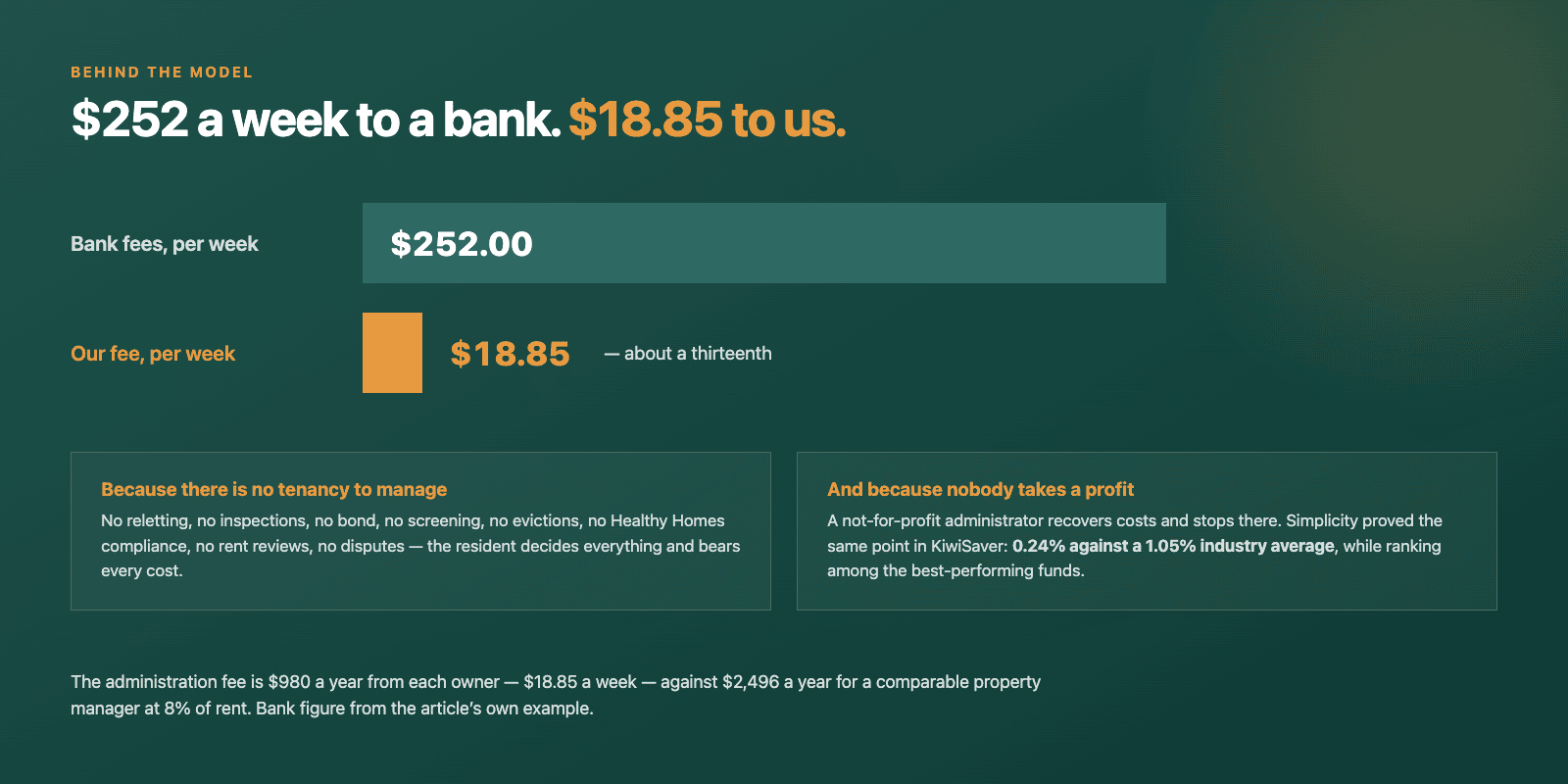
In the example for home ownership, the fees charged by Passive Partnerships compared to a bank are significantly lower ($252 per week for banks compared to about $18.85 for Passive Partnerships). They are so low it may call into question the viability of us as the Passive Partnership Administrator. Below is an explanation of how it is viable, and how we want to lower them further. We also include some good real-world examples of how and why this is realistic.
The most comparable service model to Passive Partnerships is a property management service that gets paid to manage the tenant/landlord processes.
In the example on the website, at 8% of rent the property management fees would work out to be $2,496 per year (the full amount is typically much higher than this once all the extra fees are added).
For Passive Partnerships the equivalent fee is $980 per year — around 50% less than a comparable property management service — but $980 is also paid by the Resident Owner, making it close to $2,000 per year.
We also charge a fixed one-off set-up fee to establish an agreement. It is more like the cost of setting up a bank mortgage and includes registering title (roughly $2,000 on a pure cost-recovery basis — banks are much higher).
Why our fees can be lower than a property manager
Our fees can be lower because there is a long list of things we don’t have to do with this co-ownership model
- no tenancy act as co-owners are tenants in common so tenancy act does not apply
- no reletting/ advertising
- no inspections
- no managing repairs and maintenance
- no conflict/disputes (resident makes all decisions and bears all costs, risks and rewards)
- no setting rent increase
- much less likely need for chasing payments etc, because the Owner has so much more of their own capital at risk. There is an additional fee we will only charge for people who miss payments.
- no dealing with accountants etc (you get a yearly tax statement similar to a bank)
- no bond or deposit management
- no tenant screening or reference checks
- no void periods or vacancy losses (the co-owner has every incentive to stay in the property)
- no eviction proceedings
- no healthy homes compliance obligations (these apply to landlords, not co-owners)
- no lease drafting or renewals
- no profit — we are a not-for-profit organisation
We charge this administration fee on the whole property value and split it 50:50 between the two owners, so each pays half. You can see how we realistically hope to be able to lower these fees in the future.
Examples of how this works in related industries
Index funds like Simplicity are a great example of how a non-profit organisation can have much lower fees while being high-quality and very successful.
In a similar way to us, they avoid the extra costs that other organisations carry. Below is a clear comparison and breakdown:
Industry average vs Simplicity
The KiwiSaver Annual Report 2025 puts total KiwiSaver fees at $868.5 million. For growth funds specifically, the average fee for $30,000 invested in a KiwiSaver growth fund was 1.05% per annum as at August 2025.
Simplicity cut its fee to 0.24% per annum on 1 September 2025 — its seventh fee reduction since launching in 2016. So Simplicity charges roughly one quarter of what the average growth fund manager charges.
Simplicity are consistently voted one of the best KiwiSaver funds in NZ while also providing high returns compared to other providers.
Just as Simplicity demonstrated that a non-profit model can outperform the incumbents by eliminating unnecessary costs, Passive Partnerships applies the same logic to property co-ownership.
According to S&P Global’s SPIVA Scorecard — the most comprehensive long-running study of active versus passive investing, tracking data since 2002 — over 90% of actively managed US equity funds underperformed a simple index fund over the 20-year period to end-2025, and the same pattern holds across virtually every major market studied globally. Because of this evidence, many trillions of dollars have moved from high-fee funds to low-cost index funds, and we are using the same logic for property investment.
In summary, our fees are intentionally low — a core part of our design to make property investing more profitable and homeownership more viable for more people. We set fees at a level that ensures we remain a long-term viable organisation.
See it for yourself
Run your own numbers in the calculators, or join the waitlist to be part of the first cohort.
Open the calculators → Join the waitlist →