The economics
Equity and house price risk: home loan vs Passive Partnership
Both let you live in and build equity in a home — but they expose you to house-price risk in very different ways. And only one can push you into negative equity.
Both a home loan and a Passive Partnership (PP) let you live in and build equity in a property — but they expose you to house-price risk in very different ways. This article explains the structural differences and what they mean in practice. To try it with your own numbers, use the equity & house-price risk calculator.
How each system works
The fundamental difference is ownership structure. With a home loan, the bank finances your full ownership from day one, and you bear 100% of the risk and reward. With PP, you and a passive investor co-own the property in proportion to your contributions, and you buy more of it over time.
| Home loan | Passive Partnership | |
|---|---|---|
| Who owns it? | You (100% from day one), financed by the bank. | You and a passive investor, co-owning in proportion to your deposit. You can buy more each week. |
| Weekly payment | Mortgage repayments: interest + principal to the bank. | Occupancy fee to the passive investor (a % of their share of property value), plus optional top-ups to buy more equity. |
| How equity grows | Principal repayments + any house-price gains. | Weekly equity purchases, regardless of price direction. Falling prices mean each dollar buys more. |
| If prices fall | Equity falls dollar-for-dollar. Risk of negative equity — unable to sell. | The passive owner absorbs the loss on their share. Your equity falls only on your portion, and buying becomes cheaper. |
| Upside potential | High — 100% of price gains. | Grows with your ownership stake. Lower early upside, but consistent accumulation with less risk. |
| Can you switch to a full loan? | Already there. | Yes — at any point you can buy out the passive owner with a home loan if you choose. |
The core trade-off: a home loan gives you full ownership and full exposure to price movements from day one. PP gives you growing ownership with much lower downside risk, but smaller early gains if prices rise sharply.
House price risk
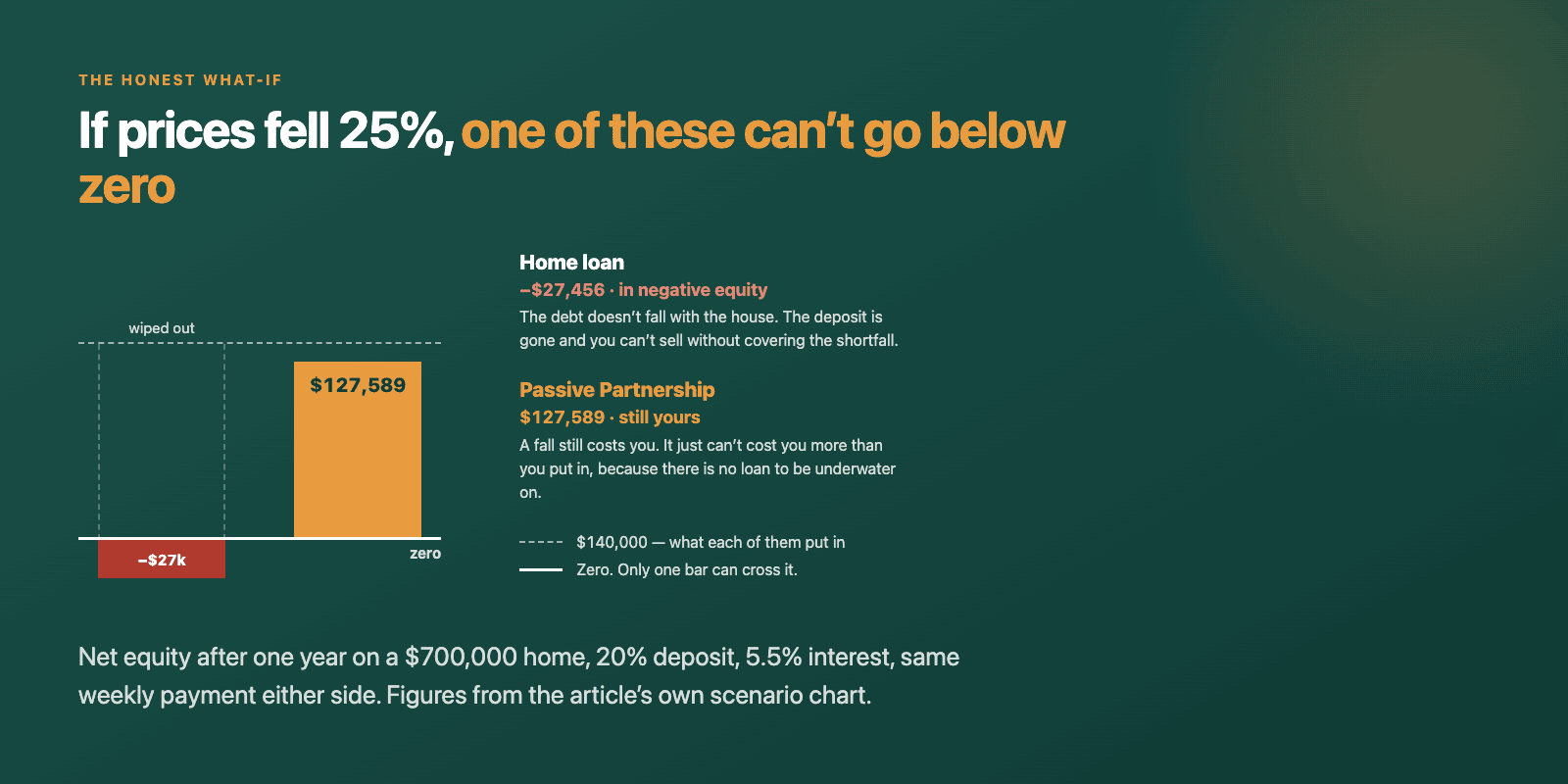
The chart below shows net equity after one year across five price scenarios, based on a $700,000 property with a 20% deposit at 5.5% interest — assuming the same weekly payment in both cases. The red dashed line marks the $140,000 starting equity: everything above it is a gain, everything below is a loss.
With a home loan, gains and losses are amplified in full — you own 100% of the property, so every price move hits your equity directly. At +25%, this leverage works strongly in your favour. At −25%, it wipes out your deposit and pushes you into negative equity.
PP shows a different pattern. Because the passive owner holds the majority share early on, your equity exposure to price falls is limited to your ownership percentage. You are also steadily buying more equity each week, which means your position improves regardless of what prices do — falling prices actually mean each purchase goes further.
The leveraged bet
A large mortgage is a leveraged bet on property prices — it amplifies gains when prices rise, but also amplifies losses when they don't. This has paid off for many New Zealand borrowers over the past 40 years, but prices have been flat or falling for five years, and the future is unknowable.
Until now, a home loan was the only path to home ownership, so accepting that risk was unavoidable. PP changes that. You build equity steadily and safely, with the option to buy out the passive owner and switch to a full home loan at any point if you want to take on the full market exposure. It also opens home ownership to people who cannot pass a bank's serviceability test — letting them start building equity and security sooner, rather than continuing to pay rent with nothing to show for it.
Use the risk calculator to explore how these scenarios play out with your specific numbers.